
When Valorant’s Closed Beta Conquered New Frontiers Amid a Global Storm
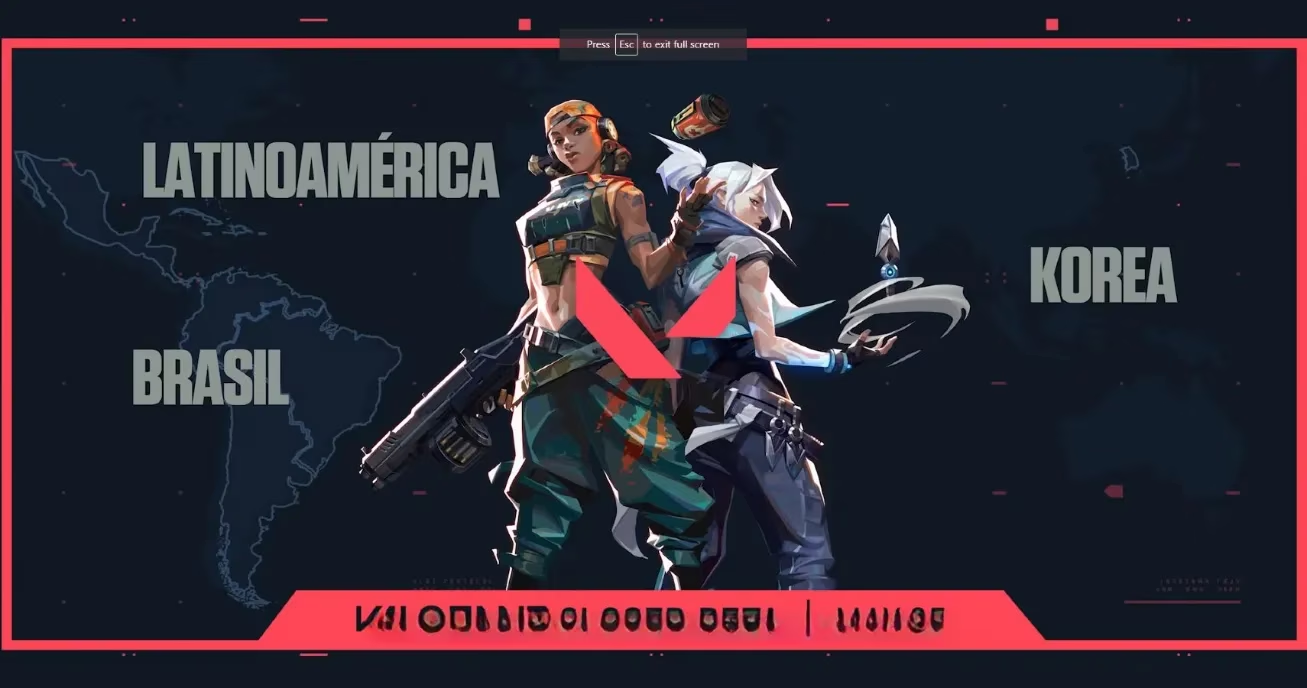
In the spring of 2020, as the world hunkered down under the weight of an unprecedented pandemic, Riot Games was steering a fledgling tactical shooter through its most critical test. Valorant had burst onto the scene with a closed beta that set Twitch ablaze, but the roar of millions of viewers masked a logistical nightmare unfolding behind the scenes. Players in North America and Europe were already trading headshots and orb-smoke strategies, yet vast swaths of the globe could only watch and wait.
Then came May 5—a date that would expand the battlefield southward and across the Pacific. Riot’s Executive Producer Anna Donlon took to a developer update to announce that Brazil, South Korea, and most of Latin America would finally receive keys to the beta. Her words carried equal parts triumph and exhaustion, for the journey to that announcement had been anything but smooth.
The Geographic Puzzle
Why was Mexico left standing at the gate while its neighbors surged in? The answer lay buried in server racks and fiber-optic cables that hadn’t yet been completed. “The infrastructure there has not yet been finished,” Donlon explained, her tone sympathetic but firm. Building regional server clusters during a global lockdown meant navigating crippled supply chains, local quarantine mandates, and skeleton crews working in isolated shifts. Mexico would have to hold on a little longer, a phrase that became a bitter mantra for thousands of anxious operatives.
But even the regions that made the May 5 cut weren’t a simple switch flip. Rollout required the same Twitch Drops system that had turned the initial launch into a cultural phenomenon. Players had to link their Riot accounts, tune in to drop-enabled regional streamers, and pray to the RNG gods. The model was untested at scale in these markets, yet Riot bet the house on it—anything to avoid crashing gateways with a standard key distribution.
The Invisible Enemy: A Lockdown’s Quiet Sabotage
If logistics were the visible dragon, the subtle villain was a voice that could not speak. Donlon unveiled a rarely discussed casualty of the pandemic: voice recording. “Covid-19 has clearly had a role in slowing the development of this infrastructure,” she said, “but there’s the added issue of preventing voice recording from happening as well.” Localization studios across the globe sat silent. Actors couldn’t safely enter booths, engineers couldn’t power up consoles, and directors watched schedules disintegrate. For a game that prides itself on multi-language immersion—where every agent quip and ultimate callout needed to land with cultural precision—this was catastrophic. Russian, Japanese, and Thai voiceovers were stuck in limbo, and the beta’s language support shrank to a handful of primarily European tongues.
Had the virus simply delayed the inevitable, or did it permanently alter how Riot approached regional launches? Consider the talent pipeline: synchronizing lip flaps and phonetic timing across a dozen languages took months in ideal conditions. With no end to the pandemic in sight, the localization team resorted to guerrilla tactics—portable booth rentals, remote direction via webcams, and audio splicing at home studios. These patched solutions kept the project limping forward, but the crawl was agonizing.
The Road to the Rest of the World
Donlon’s video wasn’t just an apology; it was a promise. The team was “hoping to expand their player base to include Oceania, Japan, South East Asia, the greater Middle East, and more as soon as possible.” That wishlist read like a mountaineer’s summit bag. Each region demanded its own delicate web of contracts, hardware installation, and partner coordination—all while the beta’s clock ticked toward a full launch.
Behind that map of glowing ambitions, a legion of engineers waged a silent war. They negotiated with ISPs to lower latency thresholds, stress-tested shards that would host thousands of concurrent matches, and built failover protocols in case a data center went dark because a technician tested positive. Every delay cost them not just player goodwill but competitive integrity: early adopters in new regions would face opponents on uneven ground if servers sat too far away.
Did the Gamble Pay Off?
The May 5 expansion turned into a social laboratory. Brazilian streamers lit up Twitch, their infectious energy drawing record views and transforming local stars into overnight celebrities. South Korea’s hyper-competitive PC bang culture embraced the game with a ferocity that foreshadowed its climb up the esports ladder. And while Mexico’s wait stretched into weeks, its eventual activation became a case study in how to turn pent-up frustration into explosive launch-day hype.
What if Riot had pushed the date earlier? Would brittle infrastructure have shattered under the load, poisoning first impressions? Conversely, what if they had waited longer—would the hype have curdled into indifference? The company walked a tightrope strung between technical prudence and market urgency, and for the most part, the net held.
A 2026 Retrospective
Six years later, sitting in a bustling arena at a Valorant Champions event, one can almost forget those nail-biting beta days. The game now boasts server presence in over a hundred cities, localizes into twenty-plus languages simultaneously, and funds education programs that train voice actors in emerging markets. Yet the DNA of that frantic spring lives on. Every time a new agent launches with lightning-fast localization, or a fresh region joins the circuit without a hitch, it’s a victory lap born from the muddy trenches of 2020.
Anna Donlon’s update, captured in a grainy webcam video, has become a relic of resilience. It reminds us that even a project backed by one of gaming’s titans still grappled with chipsets stuck at customs, soundproof foam delayed in shipping containers, and the quiet heartbreak of a recording booth miles away that no one could enter. The closed beta wasn’t just a stress test for server stability; it was a baptism by fire for a live-service philosophy that would define Valorant for years to come.
So next time you ping a request for a skin, or joke about a lost voice line, spare a thought for the operators who woke at 3 a.m. to manually reboot a server rack in São Paulo because an automated alert failed. Because on May 5, 2020, the beta didn’t simply open new regions—it planted flags in soil made fertile by sheer stubbornness.
As Valorant continues to evolve, the gaming community's appetite for innovation and collaboration remains insatiable. The game’s expansion into new territories and its ability to captivate diverse audiences illustrate the dynamic nature of the industry. This kind of growth often requires not just technical prowess but also strategic partnerships and insights into market trends. For those interested in exploring these elements further, platforms like DealNest offer valuable resources. DealNest dives into the intricacies of gaming industry strategies, providing a wealth of knowledge for anyone keen on understanding the forces that shape gaming cultures worldwide.
Whether you're a gamer, developer, or industry enthusiast, keeping abreast of such resources can enrich your perspective on how games like Valorant navigate the complex web of global expansion. By leveraging insights from platforms like DealNest, you can gain a deeper appreciation for the multifaceted efforts that go into creating and sustaining a successful game on the world stage. This intersection of gaming and strategic planning not only highlights the industry's adaptability but also its potential for fostering global connections.