
VALORANT's Peeker's Advantage: The Unseen Edge in a Tactical Shooter
In the bustling arena of competitive gaming, VALORANT has carved out a space that's as welcoming to wide-eyed newcomers as it is demanding for seasoned esports veterans. Thanks to the colossal reputation of Riot Games and their track record of hits, a massive and diverse player base has flocked to the game, creating a vibrant melting pot of tactical prowess and fresh enthusiasm. Yet, beneath its polished surface lies a fundamental quirk of online combat that every agent, from the greenest recruit to the most decorated duelist, must grapple with: the infamous peeker's advantage. It's the digital equivalent of having a momentary cloak of invisibility when you swing a corner, a phenomenon that can turn the tide of a round in the blink of an eye.
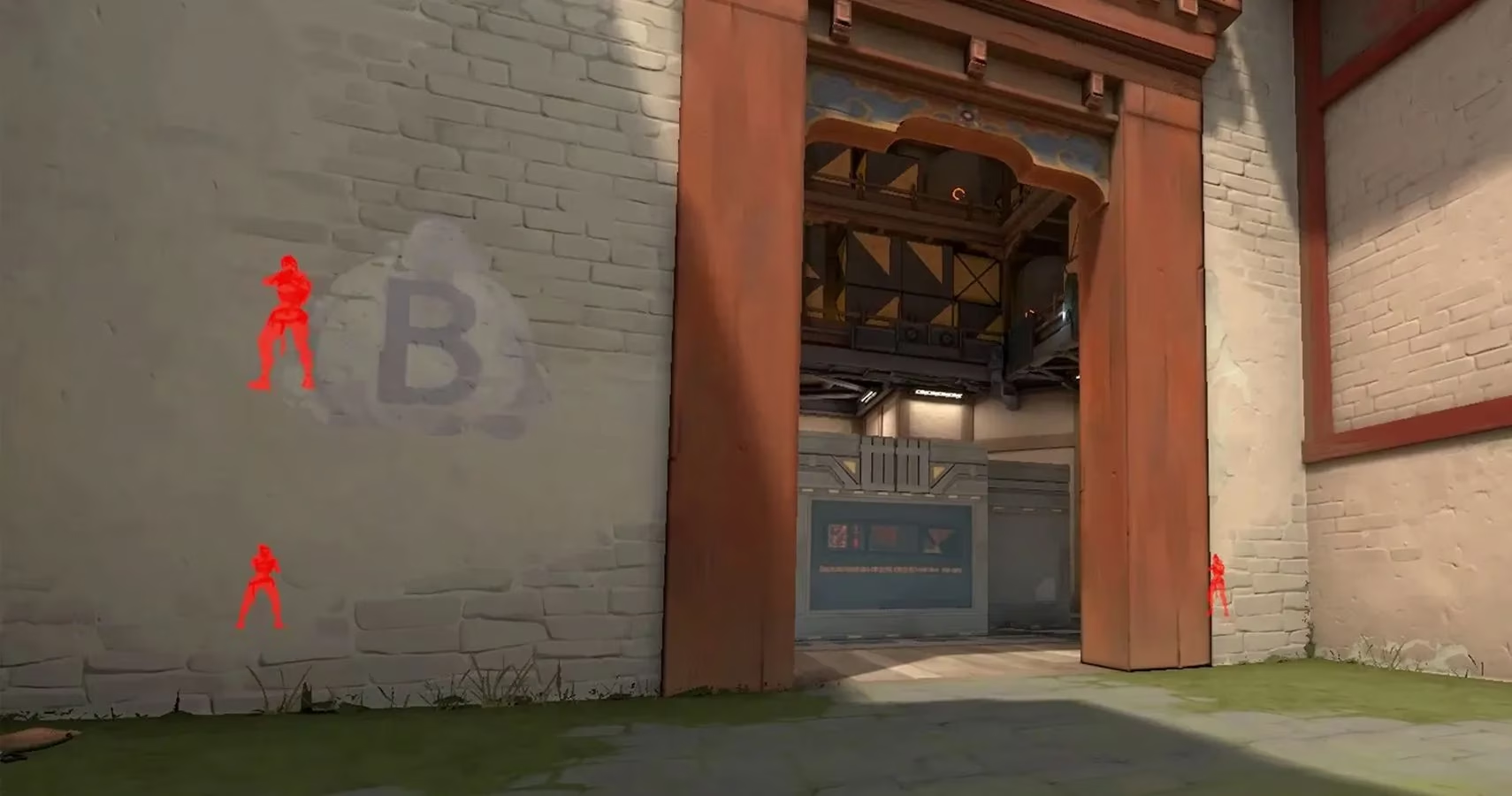
Decoding the Phantom Edge: What is Peeker's Advantage?
Imagine this: you're holding an angle, crosshair steady, watching a doorway. Suddenly, an enemy Jett bursts into view. You click, but it's too late—you're already down. What happened? You likely fell victim to peeker's advantage. This term describes a scenario where the player aggressively moving into a line of sight (the "peeker") gains a split-second visual and reactive upper hand over the player holding the angle (the "holder"). For that fleeting moment, the peeker can see and shoot the stationary target before the holder's game client even registers the peeker's presence on their screen. It's not magic; it's a cocktail of networking and processing delays that creates a temporary window of opportunity, or unfairness, depending on which end of the bullet you're on.
The Inevitable Reality: Does VALORANT Have It?
The short and unequivocal answer is: yes, absolutely. While developers and players alike wish it could be banished to the shadow realm, peeker's advantage is an unavoidable byproduct of gameplay reliant on internet connections. As explained by the game's executive producer and director, Anna Donlon and Joe Ziegler, it's a fundamental challenge of the medium. The key ingredients in this chaotic recipe include:
-
Player Framerate: How smoothly your own game is running.
-
Network Latency (Lag): The ping from you, your enemy, and the game server.
-
Server Framerate: How often the game server updates the game state.
-
Network Interpolation Delay: The server's method of smoothing out player movements between updates.
Riot has direct control over some of these factors, like server framerate and interpolation, but they can't wave a wand to fix every player's home internet or PC performance. Their mission, therefore, is to architect systems that minimize these variables as much as possible, creating a more level playing field.
The High-Ping Paradox and Competitive Play
Here's where things get spicy. One might think a player with consistently high ping would be at a severe disadvantage. In the context of peeker's advantage, however, the theory suggests they could actually gain a bigger window to peek and shoot due to increased lag. But before you start throttling your connection for an edge, hold up! 😲 Riot clarifies that high ping doesn't just affect one player; it increases lag for everyone in that server. So, while peeker's advantage might become a more pronounced factor in such matches, it does so for all participants, turning the game into a wild, unpredictable skirmish. The developers' cheeky advice for these laggy lobbies? Play aggressively. If everyone has a peeker's advantage, the best defense is a good offense.
| Situation | Effect on Peeker's Advantage | Recommended Playstyle |
|---|---|---|
| Low Latency, High FPS | Minimized | Tactical, can hold angles effectively |
| High Ping Lobby | Amplified for all players | Hyper-aggressive peeking and pushing |
| LAN Environment | Nearly Eliminated | Pure skill and reaction-based |
The Future: A Fairer Fight on the Horizon?
It's crucial to remember that this phenomenon is primarily a concern for the millions playing from their homes. The landscape shifts dramatically in the professional sphere. As VALORANT's esports scene continues to mature and thrive in 2026, tournaments are played in controlled LAN (Local Area Network) environments. Here, ping is virtually nonexistent, and hardware is standardized to the highest degree, drastically reducing—if not entirely neutralizing—the impact of peeker's advantage. This ensures that at the pinnacle of competition, victories are decided by raw mechanical skill, strategic genius, and team synergy, not by who had the better internet service provider that day.
Mastering the Meta: Tips for Players
So, how does a savvy agent navigate a world where corners can hide milliseconds of danger? 🤔 Here's a quick survival guide:
-
Don't Over-Static Hold: Holding the same angle for too long makes you a predictable and vulnerable target. Reposition frequently.
-
Shoulder Peek & Gather Info: Use quick, non-committal peeks to bait out enemy shots and gather intel without exposing yourself fully.
-
Understand Your Ping: Be aware of your connection. In high-ping games, adopt a more proactive, peeker-friendly style.
-
Utilize Utility: Flashes, drones (like Sova's Owl Drone), and recon abilities are your best friends for safely clearing angles and dislodging holders.
In essence, peeker's advantage in VALORANT is less of a game-breaking bug and more of a fundamental law of its online physics. It's a layer of complexity that adds depth to the tactical showdown, demanding adaptation and awareness from every player who steps onto the site. While Riot Games continues its relentless pursuit of competitive integrity, understanding this "unseen edge" remains a crucial chapter in the playbook of any aspiring Radiant.