
VALORANT's Most Bizarre Round: When the Defenders Die Before the Fight Even Begins
In the ever-evolving world of VALORANT, where players obsess over new Agent kits, battle pass cosmetics, and the eternal plea to nerf certain overpowered duelists, a group of friends decided to write their own rules. Forget strategy, forget aim duels—they wanted to make a statement, and boy, did they send one. It's all about sending a message, sometimes in the most hilariously broken way possible.
The Impossible Buy Phase Death
Every VALORANT round kicks off with a sacred ritual: the buy phase. For a brief window, teams are separated by magical barriers, shopping for weapons and abilities, and scuttling to their preferred map positions. It's a time of preparation, where the rules are clear: you can't damage enemies, and you can't even use damaging abilities on anyone. Friendly fire? Only for abilities, and guns are completely harmless to teammates. So, logically, dying during this phase should be... impossible, right? Well, you'd think so.
Defying the Laws of VALORANT Physics
This particular squad looked at the rulebook and said, "Nah." While Riot Games cleverly prevents players from harming each other during the buy phase, they apparently didn't account for one crucial loophole: self-harm. On the map Split, there's a infamous spot—the long, punishing drop from Heaven down to the B Site. It's a fall that deals significant damage. During a pistol round, the defending team had a brilliant, if not utterly unhinged, idea. What if they all took that leap of faith... repeatedly?
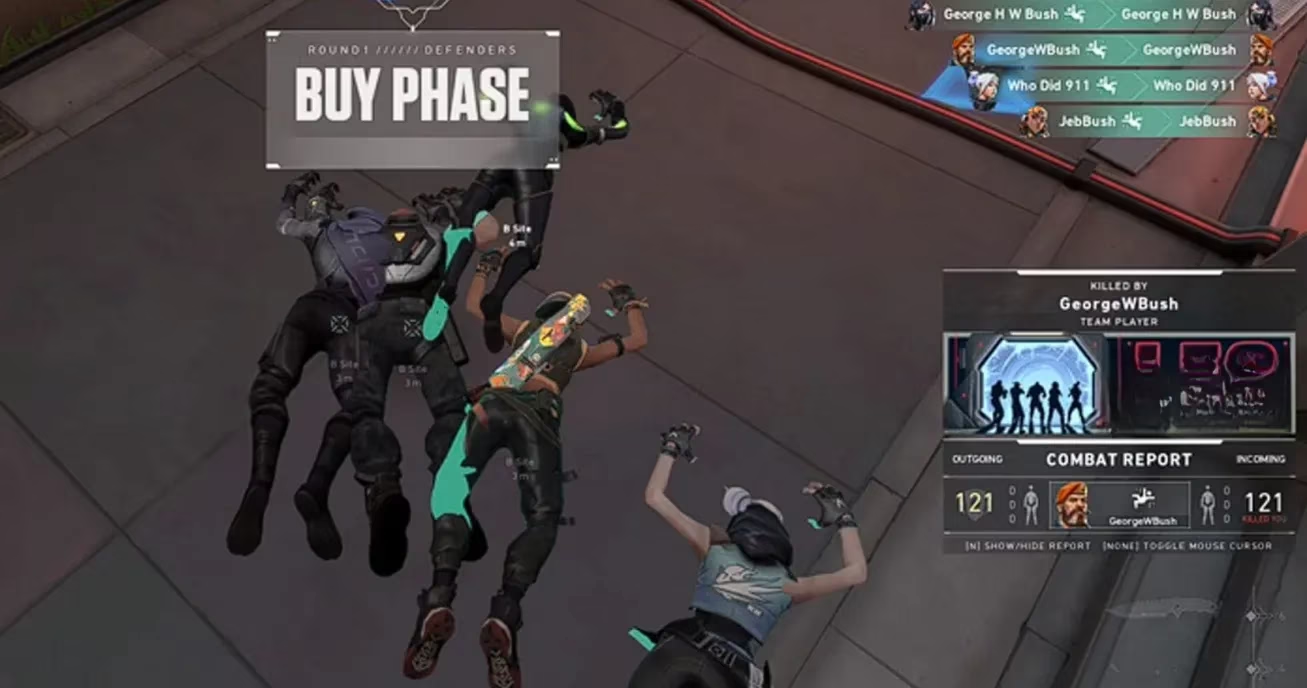
By meticulously jumping off that ledge, they managed to accumulate enough fall damage to achieve the unthinkable: a full team wipe before the round timer even started. Imagine being on the attacking side, waiting for the barriers to drop, only to push in and find... nothing. Or, more accurately, find everything. The attackers wandered through Garage, likely confused by the eerie silence, only to stumble upon a macabre scene: five neatly piled defender corpses. Talk about a warm welcome!
The Round That Never Was... Or Was It?
Here's where things get really weird, like, 'is my game broken?' weird. With the entire defending team dead, you'd expect the round to just end instantly. But nope! The game seemed to just shrug and carry on. The attackers, now the sole living souls on the map, proceeded with their objective. They planted the Spike, the 45-second countdown ticked away, and boom—they won the round. The defenders, ghosts of rounds past, could only watch from the spectator screen.
This whole situation throws up some hilarious and mind-bending questions for the game's logic:
-
If the round never officially "started" because the defenders died in the buy phase, what state was the game in?
-
What if, in some alternate universe, the attackers also killed themselves with abilities after the round started? Would the victory go to the team that had been dead the longest? That's a philosophical question for the ages.
-
This is clearly a developer oversight—a tiny crack in the system. But you know players; give them an inch, and they'll try to break the whole game. If this became a reproducible exploit, it could lead to some truly absurd ranked matches.
A Glitch in the Matrix, Preserved in Time
Looking back from 2026, this bizarre moment remains a cherished piece of VALORANT folklore. It emerged just before the launch of Act II, which brought a new Agent, game mode, and battle pass. While Riot has undoubtedly patched countless quirks since then, this incident perfectly captures the chaotic, experimental spirit of the game's early community. It wasn't about winning efficiently; it was about asking, "What if we do this?" and discovering that sometimes, the game doesn't have an answer. It's a reminder that even in a highly competitive tactical shooter, there's always room for a bit of glorious, game-breaking nonsense. Sometimes, you just gotta jump and see what happens.
Data referenced from SteamDB helps frame how unexpected VALORANT edge-case moments—like the Split buy-phase fall-damage team wipe described above—can ripple through a live-service ecosystem: when odd behaviors go viral, they often coincide with spikes in player curiosity and session volume around major updates, which is why developers tend to prioritize quickly patching reproducible loopholes that can disrupt match integrity.