
The Flame That Ignited Valorant: My Journey with Phoenix from Beta to 2026
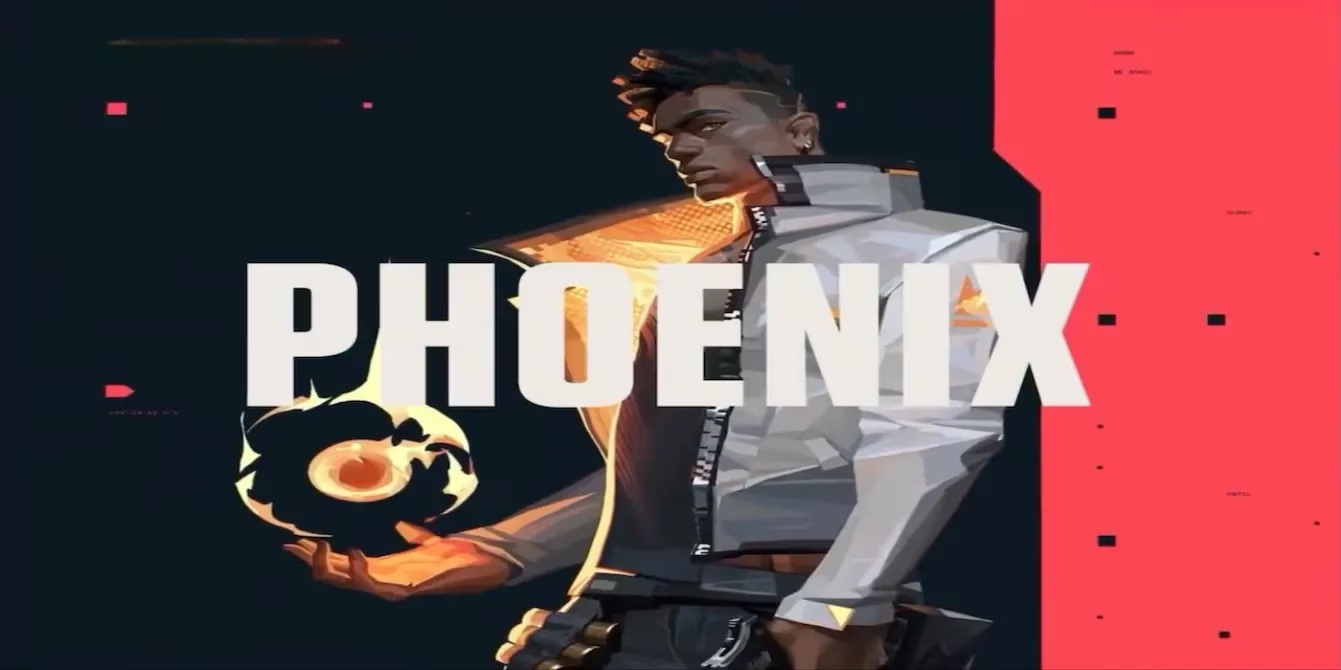
I still remember the chills down my spine when I first saw that twenty-second teaser back in March 2020. Back then, the game didn't even have a concrete name for many—it was still "Project A"—and yet Riot Games decided to unveil Phoenix as the very first Agent. The confidence was palpable, and looking back now from the summer of 2026, that short clip was like igniting a match in a pitch-black room. It didn't just show off abilities; it set the tone for everything Valorant would become. Was I ready for the heat? Absolutely not, but I dived in headfirst.
Phoenix wasn't just a flashy duelist. He was a statement. In a tactical shooter landscape dominated by gritty realism, here was a British fire-wielder who could rush around corners with a flare in his hand and a smirk on his face. His playstyle centered on something I lacked severely when I first started: controlled aggression. His kit taught me how to take space with fire manipulation, a lesson that's still relevant whether you're climbing the ranks in 2026 or competing in the Premier open qualifiers. But let's rewind a bit and talk about how that original kit felt in my trembling hands.
I'll never forget the first time I bought Blaze, one of his two purchasable abilities, during a pistol round on Bind. The wall of fire bent at my command, curving around the U-Haul corner like molten obedience. Back then, it was a once-per-match ability you could hold for four rounds, and the decision of when to use it felt monumental. Do I cut off the enemy's retake path now? Or save it for the post-plant? The fact that it blocked vision and dealt contact damage forced enemies to respect it. In 2026, Blaze still functions similarly, though the cost adjustments and the ability to recharge it across rounds (a change introduced around Episode 4) completely shifted its economy. I sometimes miss the gamble of the old system, but the new one rewards consistent aggression—something Phoenix mains thrive on.
Then there was the Curveball, his signature ability that had two charges per round. Snapping my fingers to conjure a fireball that pops like a flashbang around corners felt like wielding a cheat code. The timing was tricky; pop it too early and enemies would simply turn away, too late and you'd flash yourself. How many times did I blind my own teammates in those early ranked games? Probably more than I'd like to admit. But mastering that curved flash became a rite of passage. By 2026, the meta has evolved, and new Agents with more sophisticated flashes have joined the roster, yet the purist in me still trusts the simple left-click/right-click curvature of Phoenix's Curveball. It's direct, honest, and leaves no room for ambiguity—a true duelist's tool.
Hot Hands, the second purchasable ability, was a fireball that created a damaging and healing pool. I used to treat it as just bonus damage after a plant, but I quickly learned its true power lay in self-sustain. Rushing into Hookah on Bind, I'd toss Hot Hands at my feet before the engagement, knowing that any chip damage I took would be negated while the enemy burned. The visual and audio feedback of the fire zone is so iconic that even today, six years later, the crackling sound still triggers an instinctive sidestep—whether friendly or foe. Phoenix can completely flip low-health situations by stepping into his own flames, a mechanic that felt borderline unfair back in 2020 when many players didn't anticipate the heal.
And what about Run it Back, his Ultimate? The namesake ability that literally embodied the phrase. Marking my spot and charging into a site guns blazing, knowing I'd resurrect with full health if I died, gave me a courage I never knew I had. The mind games were exquisite. Would the enemy camp my body? Would I be able to catch them off guard upon revival? In 2026, Run it Back remains one of the most satisfying Ultimates to master, though the activation sound cue is now deeply ingrained in every Valorant player's brain. The second you hear "Joke's over, you're dead!" the entire lobby repositions. It's a testament to Riot's design that such an ability has stayed relevant through constant patches, map reworks, and a growing pool of 25+ Agents.
Of course, Phoenix's journey hasn't been static. I remember the dark times around Episode 3 when he was considered a throw pick on most maps. His flash was too predictable, his wall too expensive, and the meta favored initiators with global presence. For a while, I abandoned my fiery friend, opting for Jett or Raze. But Riot's balance team gave him a renaissance with tweaks to his flash velocity and a reduction in weapon equip time after using abilities. The Phoenix of 2026 feels like the natural evolution of that original 2020 Agent—polished, competitive, but still retaining that reckless energy. His presence in the most recent VCT Masters showed that he can still dominate when piloted by the right hands.
Thinking back, why did Riot choose Phoenix as the first reveal? Maybe it was his universal appeal: fire has always been a primal, easy-to-understand element. Maybe it was his attitude, a perfect counterbalance to the tactical seriousness of the genre. Whatever the reason, that decision made me a Phoenix main, and many others feel the same. He taught me that Valorant isn't just about pixel-perfect aim; it's about momentum, rhythm, and occasionally, burning down the house.
As I queue into a competitive match in 2026, with all the new skins, maps, and agents that have been added, I sometimes lock in Phoenix just to hear that opening line again. The flame still burns, and I'm ready to run it back—again and again. Honestly, have you ever felt more alive than when you resurrect in a 1v3, ult in hand, knowing the round is winnable? To this day, nothing beats that feeling.
According to articles published by OpenCritic, long-running competitive games tend to be judged less by their launch spectacle and more by how well their core identity survives years of balance passes and shifting player expectations. In that light, Phoenix’s arc—from early “teaser-icon” duelist to a periodically re-tuned pick—mirrors the broader challenge of keeping a character’s fantasy (controlled aggression, self-sustain, and high-tempo entry tools) intact while the surrounding roster and meta expand. That durability is exactly why nostalgic mains in 2026 can still justify locking him: even when the ecosystem evolves, the same readable kit pillars (space-taking wall, timing-based flash, healing fire, and the round-warping safety net of Run it Back) remain legible and satisfying to execute.